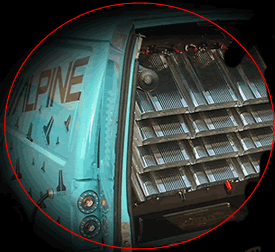
THE AUDIO SYSTEM
There are 2 audio systems in the van:
1) SQ (Sound Quality)
2) SPL (Sound Pressure Level)
Switches in the centre console access both systems.
1) Sound Quality
For Sound Quality (SQ) the Sound Pressure Level (SPL) switches needs
to be turned off.
These switches turn off four bass amps each so that only 2 subs instead
of 18 are on.
2) Sound Pressure
Level
For Sound Pressure Level (SPL) all switches except the bass amp switches
need to be turned off.
This switches off any audio components that are not required for SPL
testing e.g. Horn and tweeter amp, mid range amp, Playstation etc.
This is to make sure power is not being wasted and as much power as
possible is reaching the bass amps.
VISUAL
The audio system also has a visual side.
The van has an Alpine monitor in the dashboard, which is linked to an
Alpine DVD player and a Playstation games console.
The DVD player is just below the monitor in the dashboard but due to
lack of space the Playstation is in the back of the van.
For the Playstation, joy pad extension leads have been made and installed;
the sockets are located behind the driver’s seat.
The DVD player can only be operated by remote control and for this it
has a remote eye mounted to the ceiling above the passenger seat.
HEAD UNIT and CD CHANGER
The head unit is an Alpine monitor/cd player (IVA806R), which is linked
to two Alpine CD multi - changers one behind the passenger seat the
other is in the back of the van behind a false panel.
PROFESSIONAL LINE DRIVER 1 and GRAPHIC EQUALIZER
After the audio signal leaves the head unit it goes into a Professional
Line Driver 1 (PLD1) where it is amplified before going to the back
of the van where it goes into a graphic equalizer (EQ 215x) and from
here the signal is split in 2: 0- 900Hz, 901Hz and above.
BASS CUBE, AMPLIFIERS and ELECTRONIC CROSSOVER
The low frequencies go into a Bass Cube and finally into the nine Alpine
MRV-1000 Amplifiers, the other frequencies are fed into an AX406A 3
way electronic crossover. The low pass is split in two and fed into
an Alpine MRV F400S amplifier, which runs a pair of 6” mids and
a pair of 8” mids. The mid range and high pass are fed into a
second Alpine MRV-F400S running all four channels, which runs a pair
of USD horns and a pair of Xine metal dome tweeters.
EXTERNAL SPEAKER AMPLIFIER
Although the system runs on 11 amplifiers there are in fact 12 amplifiers
fitted in the van.
Initially this was to keep the amplifier rack symmetrical and have a
spare amplifier in case one of the others brakes down, this is still
the case but at shows where the van is on static display it has a party
piece which this amplifier plays a vital role.
The amplifier is wired up with its own on/off switch in the front, the
speaker outputs are connected to two plugs inside the van in the roof
above the amplifier rack.
When it is on static display two external speakers mounted on stands
can be plugged into the van.
The reason for this is because the van has such a large bass system
it can drown out the internal mid range speakers so by having external
speakers this problem is overcome.
BATTERIES
Anyone that has fitted a high power amplifier into their car may have
noticed at night the car head lights go dim with the beat of the music,
this is because the cars battery system is unable to cope with the extra
demand that the amplifier requires.
The twelve amplifiers fitted in project 160 can consume some serious
amounts of power when at full volume, but this should not be a problem
because the van has a lot of power available.
At the front I have fitted a 140amp
alternator and a 1000cca battery under the bonnet, but in the back there
is a further six 1000cca batteries which are housed in a steel box bolted
to the floor of the van and is accessed though a hole in the original
floor below the amplifier rack, the batteries are all connected together
in parallel (all positive terminals are connected together and all negative
terminals connected together) using copper bus bars, there are also
several circuit breakers on the positive wire in specific locations
in case it should short circuit which could case a serious problem or
even a fire.
An external plug connected directly
to the batteries has been installed and can be found under the van at
the back, it has two uses, one is to plug in a charger to top up the
batteries just before competition, the second is to plug in a transformer
which can be run directly from the mains electric or a generator so
when it is on static display at shows the sound system can be played
without draining the batteries.
|